Showing posts with label 1790. Show all posts

Sunday, December 29, 2013

*Petition Finding Aid - Josiah Harmer Papers


[draft... Fair use... Write library re: date and for copy of petition...]

Manuscripts Division
William L. Clements Library
University of Michigan
Josiah Harmar Papers, 1681-1937

[Finding aid created by Shannon Wait, April 2011]

"...After the failure of his campaign, Harmar continued to receive letters concerning news of the frontier and requests for help from settlers. Among these are a petition from the inhabitants of Clarksville, Ohio, reporting problems with Native Americans and asking for protection (December 3, 1790), and a notification that the inhabitants of Dunlap's Station planned to abandon the settlement because of an attack on their livestock and grain by natives (January 17, 1790) [sic?]. In another letter, the denizens of Bethany, Ohio, requested army protection and reported the recent killing of Abel Cook by Native Americans (February 28, 1791). Other letters concern Harmar's culpability in Harmar's Defeat; one item from John Armstrong notes, "You are censured for making detachments and the loss of some men improperly attributed to this cause" (March 1, 1791). Another from Major William Ferguson states, "Some have reported that you was intoxicated the greater part of the time, and others that misconduct had marked the whole of your expedition" (March 28, 1791). Also included is the March 18, 1791, appointment of Arthur St. Clair to succeed Harmar..."


http://quod.lib.umich.edu/c/clementsmss/umich-wcl-M-306har?view=text

Wednesday, December 25, 2013

Around an old Homestead...


https://archive.org/details/aroundanoldhome00hustgoog


Page 15
"There are few more picturesque spots than the gently rolling country of south-western Ohio. The old homestead of which I write nestles quietly among its hills. It is not far distant from the historic Fort Colerain, or Dunlap's Station, as it was sometime called, on the bluffs of the Great Miami, where, in the winter of 1790-1791, an attack was made on the garrison by Indians, led by the renegade Simon Girty, and a detachment of soldiers had to be sent out from Fort Washington, on the Ohio, to their aid. The old earthworks of the fort can yet be distinguished in outline from the highway along the river..."


1934 news


[draft... Fair use...]
[Is most of this from Burnet?]

http://www.newspapers.com/newspage/36163262/
The Journal News
11 January 1934 › Page 9
THURSDAY, JANUARY 11, 1934 
H A M I L T O N  J O U R N A L -- T H E  D A I L Y N E W S 
County Society Will Preserve History 
143 Years Ago Thursday Shawnee Indians Began Bloody Attack Upon Dunlap's Station, 10 Miles South Of Hamilton Of Today; 25 Pioneers Withstand Siege Three Days Before Rescue Party, Composed Of Early Butler Pioneers, Arrived 
By 0. LOWELL SAGER 
Following the organization of the Butler County Historic Society, Friday night, at the Y. M. C. A., present day occurrences will be systematically recorded; preserved to show future residents of Butler county, to what they owe their progress. 
Seldom does a day pass which is not the anniversary of some event reaching the part played by Butler county in acquiring and enriching the Northwest Territory for the United States. Stories kept by the historically-minded prove that Butler county pioneers were most active in making Ohio as prominent as it is today. 
As for anniversaries, January 10, was the one hundred forty-third year since a bloody Indian attack upon Dunlap's Station, just ten miles south of present-day Hamilton. Fortunately the story is preserved so that tribute may be paid to the memory of the small group of brave pioneers, whose hardships led to the building of Fort Hamilton, and the rapid progress in the Miami valley. 
Across River From Venice 
Picture Dunlap's Station at the end of the year 1790, as it stood on the Hamilton -Butler county line, across the river from Venice. A substantial blockhouse surrounded by a stockades on three sides and the murky Big Miami its protection on the fourth side, was the haven of a few pioneers who dared settle in the country north of the Ohio river, in the Miami valley. 
On the north side of the stockade the Horn, McDonald, Barrott and Barker families had built their cabins, while the White family lived south of the fort. Lieutenant Kingsbury, of the United States Army, ruled over his garrison of twelve soldiers within the stockade. Their names were Taylor, Neef, O'Neal, O'Leary, Lincoln, Grant, Strong, Sowers, Murphy, Abel, McVicar and Wiseman.
Explorers Attacked 
Few Indians were seen in the neighborhood until January 8, 1791. On that day, four explorers, Sloan, Hunt, Cunningham and Wallace, had breakfast in their camp across the river below Dunlap, only to be attacked by what appeared to be a small party of Indian scouts. 
Thence follows the story which might well have been recounted to pioneer children to terrify them into staying in their own backyards. Cunningham was killed outright; Hunt taken captive; and Sloan, though wounded, escaped with Wallace to Dunlap Station. 
Of course, the garrison at the Station was afraid of immediate attack. The few families outside the stockade were quickly assembled in the blockhouse with all their portable belongings. A steady rain, changing to snow during the afternoon, added to the strain of the watchers in the fort. As no sign of Indian campfires could be seen, Wallace crossed the river with a scouting party and buried Cunningham. The party encountered no Indians.
Fortunately Lacked a Bed 
Fear of attack grew loss intense because no Indians appeared and the scare was attributed to a small scout party. At nightfall, sentinels were posted as a matter of routine. Most of the garrison retired for the night, except a few timid inmates and Lieutenant Kingsbury, who had no bed to go to because the wounded explorer, Sloan, occupied it. It was fortunate for the group that Kingsbury had no bed, for the weary guards went to sleep.
At dawn, Lieutenant Kingsbury wishing to find quarters in the enclosure, opened the door of the blockhouse, only to find several Indians creeping toward him. He quickly barred the door, woke the garrison, and the siege was on. 
Outlaw Leads Shawnees 
About 350 Shawnees, led by their chief, Blue Jacket, and a notorious white outlaw, Simon Girty, surrounded the fort. Fearing to show himself before the besieged, Girty caused Hunt, prisoner of 24 hours, to be led out to act as interpreter for the Indians in their demand that the little garrison surrender. And Hunt begged that Dunlap surrender to the Indians in order to prevent his being tortured in revenge. During the parley, the besieged gave their answer by taking pot-shots at the Indians. 
The attack began on Sunday morning, January 9, 1791. The besieged had just enough bullets to allow each of the 26 men about 24 shots. Upon learning tho scarcity of shot, the women began casting their pewter plates and spoons into bullets, and joined the men in jeering the enemy
Three-Day Siege Starts 
Thus began a three day fight. The first night, Hunt, prisoner of the savages, was partly stripped, tied cruelly in the clearing before the fort and tortured to death, slowly, throughout the night. During the next day, January 10, Wallace and an 18-year-old soldier, Wiseman, managed to leave the fort in a canoe, to seek aid from Fort Washington. The Indians, thinking to capture the fort before reinforcements could arrive, continued the siege until January 11, and then fled.
Thomas Irwin, a member of the rescue party, and later a resident of Butler county, said that a hunter, named Cox, heard firing at Dunlap and returned to an outpost on the Ohio river to give alarm of the attack. A rescue party was formed, including young John Reily, Patrick Moore, and Samuel Davis, all of whom later became prominent citizens of Butler county. The rescuers met Wallace and Wiseman, who were bound for Fort Washington. Upon learning more details of the attack, the party fairly sped to Dunlap, only to find that the Indians had left and one man in the garrison had been killed. Fear of another attack led the pioneers to abandon Dunlap and return to Fort Washington. No one then settled the Big Miami valley until the building of Fort Hamilton, in September 1791, amid the subsequent treaty with the Indians at Greenville, which left the Ohio country free from savage raids."
Content Source:Ancestry.com 
Lccn:sn88077322 
Literal Title:Hamilton Daily News Journal 

Newspaper: The Journal News › 1934 › January › 11 January 1934 › Page 9


Monday, December 23, 2013

Family Tree of Christopher W. Lane


Medieval map of Ireland

Family Tree of Christopher W. Lane

Entries: 9975    Updated: 2006-04-04 11:19:04 UTC (Tue)    Contact: Christopher W. Lane 


  • ID: I3265
  • Name: William Cronis Crum 1 2
  • Name: William Cronis Crumm 3
  • Sex: M
  • Change Date: 18 NOV 2004
  • Birth: 1770
  • Note:
    Barb Johnson gives birth place as nr. Bethlehem, PA (Lower Saucon Twsp) and date between 1768 and 1770, and eastern Indiana web site said New York.
    1
  • Death: 14 NOV 1822 in Wayne Co., Indiana
  • Note: William was said to be killed by Indians in Ohio (cf. George C. Mansfield Butler Co. History), but he did write a will and died but two months later, and there doesn't seem to be any Indian activities that might have caused this in 1822, so this seems like it might be more a nice story than the truth. 2
  • Will: 14 NOV 1822 2
  • Event: Proved 03 JAN 1823
  • Note: Wayne Co., IN 2
  • Residence: ABT 1790 Fort Coleraine (Dunlap's Station), Hamilton Co., Ohio
  • Note:
    Listed as being one of early settlers at Fort Coleraine in Nelson's History of Hamilton Co. (1894), along with brothers David and John, and brother-in-law Henry Whitinger. He was there by April 1790.

    Also, said to be among the 11 families that first settled Fort Dunlap was his widowed mother Mary and his sister Rebecca.

    According to Wiseman's account, William was attacked by Indians along with David Gibson, who was captured, and Thomas Larrison, who with William escaped back to the fort. Samuel Hahn indicates Gibson was captured when out on his own, so Wiseman may have confused two separate events.

    After the Indian attack in Jan. 1791, all the inhabitant of Dunlap's Station abandoned it to move to North Bend. William was one of the signers of a document sent from Fort Coleraine on January 17, 1791 saying that they were going to leave Fort Coleraine because of the disadvantages cause by the attack of the "Savages." The fort was reestablished the next year, but William seems to have moved on to Daraugh's Station.
    4 5
  • Note:
    William was at fort during the Indian attack. About 500 Indians attacked the station, which was defended by Lieutenant Kingsbury, thirteen regulars and about eight to ten armed residents. The Indians attacked on the 10th, tortured a prisoner within sight of the fort that night, then attacked the next day until they heard that reinforcements were coming, when they gave up the attack.

    The account by Wiseman says the attack was led by Blue Jacket and Simon Girty.

    6 7 5
  • Event: Milit-Serv NOV 1791
  • Note:
    William was a scout for General St. Clair during the battle with the Indians on the Wabash in Nov. 1791 and elsewhere. Known as "a red-headed Indian Scout" in Mary Coates Martin's "Colonial Pioneers, Martin and Bell Families and their Kin." Tradition that he was of Scoth-Irish descent. Also tradition that the character of Nathaniel Bumppo in "Leather Stocking Tales" was based on William
    8
  • Residence: 1818
  • Note: Had moved to Indiana by this date
  • Residence: AFT 1783 Kentucky
  • Note:
    William had moved into Kentucky shortly after the Revolution (when it was still part of VA). 
    9 4
  • Residence: BET 1790 AND 1812 Coleraine Township, Hamilton Co., Ohio
  • Note:
    William was at Dunlap's Station from about 1790 to 1792, at which time he moved, along with the other settlers, to North Bend and then on to Daraugh's Station He later moved to a property where he set up a farm that he eventually passed on to Abraham.

    It appears that William Crum, and the other settlers at Dunlap's Station, found that John Dunlap did not have clear title to the land he had sold them.
    These settlers, however, applied for forfeiture land where the original owner had not made improvements. On 19 April 1798 William received forfeit of the NE corner of Section 4 in Coleraine township, located at what is now the intersection of Springdale and Pippin Roads. He lieved there until 1812, when he sold the tract to his older brother Abraham.

    William built a cabin and married Rosanah Whitinger. He worked for the army located at Fort William as a scout, etc. 
    4 10
  • Residence: ABT 1812 Wayne Co., Indiana
  • Note: William recieved a grant of land in range 10, Twp. 15 of Wayne County, IN (later Rush County) in 1811. William and his family then moved to Indiana where he lived the rest of his life. 8
  • Residence: 1792 Daraugh's Station, Hamilton Co., Ohio
  • Note:
    William was one of the first settlers at Daraugh's Station, which he moved to after leaving Dunlap's Station in the spring of 1792.

    He was out on a hunting trip with three other men when they heard a group of Indians coming. One of the men, falling behind, was wounded by an Indian, but William stopped and shot the Indian so the man could be got back to the fort. All the settlers survived the fight at the fort that followed. Note that this might have occured at Dunlap's Station a year or so earlier.
    11 3
  • Event: Milit-Serv ABT 1812
  • Note: William was a captain in the Army during the War of 1812. 8
  • Note: The "Cronis" middle name is not certain.
  • OBJE:
  • FORM: JPEG
  • FILE: C:\Program Files\The Master Genealogist\pics\signatures.JPG
  • Note: Signatures from document sent from Fort Coleraine asking for orders on January 17, 1791. Includes William Crum and Henry Whitinger.
  • OBJE:
  • FORM: JPEG
  • Title: Dunlap's Station
  • FILE: C:\Program Files\The Master Genealogist\pics\fort dunlap.jpg
  • Note: 1791 "Plan of a Settlement Call'd Dunlaps Station." Drawn by Lieutenant Bartholomew Shaumurgh. Original located in Josiah Harmar Papers, William L. Clements Library, Ann Arbor, MI. A manuscript note on the side says that the house roofs were sloped with the lower side facing out and that Lt. Shaumurgh had them modified to they sloped up towards the outside for greater safety.
  • OBJE:
  • FORM: JPEG
  • Title: Colerain Township
  • FILE: C:\Program Files\The Master Genealogist\pics\colerain twsp.jpg
  • Note: Map showing site of Dunlap's Station. By Richard Scamyhorn from "Stockades In The Wilderness."
  • OBJE:
  • FORM: JPEG
  • Title: 1896 aerial view of Dunlap's S
  • FILE: C:\Program Files\The Master Genealogist\pics\colerain photo.jpg
  • OBJE:
  • FORM: JPEG
  • Title: Dunlap's Station map
  • FILE: c:\Program Files\The Master Genealogist\pics\Colerain 2.jpg
  • Note: Modern map showing site of Dunlap's Station and Darrah's Station.

    Father: Peter Crum b: ABT 1740 in Somerset Co., New Jersey
    Mother: Mary Cronis b: ?unknown

    Marriage 1 Roseanna Whitinger b: ABT 1784 in Pennsylvania
    • Married: ABT 1795 in Fort Hamilton, Hamilton Co., Ohio
    • Note: Gene Connor believes the marriage took place at Daraught's Station, just south of Fort Hamilton. 9

    Sources:
    1. Title: Eastern Indiana Crum Family web site, Url: http://members.aol.com/indycrums/
      Abbrev: Eastern Indiana Crum Family web site
      Publication: Mid to late 1990s.
      Note:
      Site disappeared shortly after I first recorded the information from it.
    2. Title: Crum family tree, Author Address: <barlor@marsweb.com>
      Abbrev: Crum family tree
      Author: Johnson, Barb
      Note:
      Have updated tree from Peter down, and have been in correspondence with Barabara. Makes some definite mistakes and other information seems speculative.
      Repository:
        Name: Living /Lane/
    3. Title: The Pennsylvania Magazine of History and Biography: A Frontiersman's Memoirs: Jacob Felton's Sketch Of His Early Life, Volume: Vol. CVI., Pages: 539-553
      Abbrev: Jacob Felton's Memoirs
      Author: Felton, Jacob
      Publication: Oct. 1982
      Note:
      Written by Jacob Felton at age seventy-six, based on his memory and tales told by his father.
      Repository:
        Name: Philadelphia Print Shop Library

      Page: p. 542
    4. Title: Coleraine Pageant: First Families Of Coleraine
      Abbrev: First Families Of Coleraine
      Publication: 1991
      Note:
      The Coleraine Pagent is a quarterly publicatin of the Coleraine Township Hist. Society.
    5. Title: Sketches and statistics of Cincinnati in 1859
      Abbrev: Cincinnati in 1859
      Author: Cist, Charles
      Publication: 1859?
      Note:
      In 1850, Cist spoke with two survivors of the attack on Dunlap's Station: William Wiseman, an orderly-sergeant to Lt. Kingsbury, and Samuel Hahn, a child who lived there.
      Repository:
        Name: HeritageQuest data base

      Page: p.92ff.
    6. Title: Stockades in the Wilderness
      Abbrev: Stockades in the Wilderness
      Author: Scamyhorn, Richard and John Steinle
      Publication: Landfall Press, Dayton, OH, 1986
      Note:
      Have photocopies of many of the pages of this book
      Repository:
        Name: Living /Lane/
    7. Title: History of Hamilton County, Ohio
      Abbrev: History of Hamilton County, Ohio
      Author: Ford, Henry A. & Kate B. Ford
      Publication: Cleveland, 1881
      Repository:
        Name: Cincinnati Historical Society
    8. Title: Research of Gene Connor
      Abbrev: Research of Gene Connor
      Author: Connor, Gene
      Publication: Various
      Note:
      Has done a lot of digging, and though some information is questionable, he has some good data.
    9. Title: Research of Gail Vanderhoof, Author Address: <gailweld@peoplepc.com>
      Abbrev: Research of Gail Vanderhoof
      Author: Vanderhoof, Gail (nee Weld)
    10. Title: Coleraine Pageant: Ancestors Corner
      Abbrev: Ancestors Corner
      Author: Hughes, Joan
      Publication: 2004
    11. Title: Stockades in the Wilderness
      Abbrev: Stockades in the Wilderness
      Author: Scamyhorn, Richard and John Steinle
      Publication: Landfall Press, Dayton, OH, 1986
      Note:
      Have photocopies of many of the pages of this book
      Repository:
        Name: Living /Lane/

      Page: p.39

  • *Birkit draft for Hamilton & Clinton Co's forums...


    Just found this old book with a fascinating discussion of my 5GGGPa, Martin Burget...
    A lot of this seems to be uncooroborated... I haven't even found many other works which use this for a source.
    Definately worth reading, though. See ... Here are key quotes.

    • Olden, J. G. Historical Sketches and Early Reminiscences of Hamilton County, Ohio : Including a Brief History of the Early Churches and of the Settlement of the Millcreek Valley. Cincinnati, Ohio: H. Watkins printer, 1882. 294 pages:

    1922 - Memoirs of Benjamin Van Cleve (1773-1821)


    Draft. Exerpts transcribed for Fair Use only. Emphasis added.

    He was about 18 years old.
    https://archive.org/details/memoirsofbenjami00vancrich
    Parts first published in American Pioneer, Vol. II, pg 148
    ---

    Quarterly Publication of the Historical and Philosophical Society of Ohio
    Vol. XVII, 1922, Nos. 1 and 2
    JANUARY-JUNE
    Memoirs of Benjamin Van Cleve
    Edited by
    BEVERLEY W. BOND, JR.
    Associate Professor of History, University of Cincinnati
    CINCINNATI
    THE ABINGDON PRESS


    "...January, 2nd, 1790 on the day of his arrival. Mr. Tappan and who came down with us & who remained only a short time & William McMillan, Esq. were appointed Justices of a Peace for this town which the governor altered the name of, from Losantiville to Cincinnati. Two settlements at that time were Columbia, Cincinnati and North Bend. I am not certain whether there were any other but am inclined to believe the settlements at Coleraine or Dunlap station and Round bottom had commenced South Bend and but Ludlow station were settled soon afterwards...
    17
    ---
    "the Ohio belonged to Major Leech.21 In order to form a settlement thereon & to have a farm opened for himself he offered an hundred acres for clearing & fencing of each ten acre field with the use of the cleared land for three years. The majority of the settlers were to make choice of the corner of his tract where three time the quantity of land due to the setlers was to be surveyed into lots & then the setlers to draw by ballot for the first choice. My father allowed me to engage as one of the settlers (I being then 18 years old) He calculated on assisting so that we might each get at least 100 acres. It was about the middle of March 1791 that I left home. The setlers consisted of four men with families & four of us single men. We first erected what was generally termed a station. Each family occupied a Block house & I am now uncertain whether we put up stockades or not. We were very industrious & progressed with our clearing for Corn until about the last of April when one of Mr. Fowlers sons was killed by an accident He was a lad of about 16 years old & the old Gentlemans main dependance & the family became discouraged & moved away.
    In the winter preceding22 about 400 Indians had made an attack on Dunlaps Station on the Great Miami & continued the seige for about 26 hours, had killed all the stock destroyed the grain & burnt all the out-buildings. Before they reached the Station they killed Mr. Cunningham wounded Mr Sloan & took Abner Hunt prisoner who they massacred in a most shocking manner within sight & hearing of the people of the Station. The Garrison consisted of thirty five regulars under the Command of Capt Kingsbury & about fifteen effective men of the inhabitants one of the soldiers received a slight wound & several Indians were killed. I was among the party that came to their relief & in a second tour assisted to repair their fortifications at which time I boarded at Mr Hahn's who was killed with two of his neighbours at one time & his eldest son & several others at another shortly after. The Indians had now become so daring as to skulk thro the streets at night & through the gardens around Fort Washington. Besides many hairbreadth escapes we had news daily of persons killed on the Little Miami or on the Great...
    ----
    21 This settlement, founded by Major David Leitch, was known as Leitch's Station. Collins, Kentucky, II, 24.
    22 This paragraph, and the greater part of the following one, has been printed in the American Pioneer, II, 148-50. For the attack upon Dunlop's Station, Cf. Greve, Cincinnati, I, 284-287; McBride, Pioneer Biog. I, 14 + .

    19"


    1976 - Our Heritage: Colerain Township, Ohio. Colerain Twp.Bicentennial Committee


    (Draft... Transcribed for Fair Use only.)

    (Google: 1976 "Our Heritage" Colerain Ohio Bicentennial Committee)

    [Was this an early version of the 1994 book? See: 'The new book, "Colerain Township Revisited" will include some information from a cookbook history published by the historical society years ago. Wells is updating the information through 1993 and is organizing the information in what she hopes will be a clearer fashion.']

    http://www.worldcat.org/title/our-heritage-colerain-township/oclc/11833826


    -----

    The Bevis Family

    Posted by Carol Eddleman 
    The Bevis Family
    June 14, 2011 01:12PM


    THE BEVIS FAMILY 

    Dr. Howard L. Bevis, who died at Columbus, Ohio April 24, 1968 
    was a descendant of this pioneer family who were among the early 
    settlers of the Northwest Territory. He was a graduate of the 
    University of Cincinnati, receiving a Bachelor's degree and a law 
    degree there. He taught law at UC and was the secretary of the 
    Charter Amendment Committee which organized the Charter Party in 
    Cincinnati. He was appointed state director of finance in 1931 and 
    in 1933 became an associate justice of the Ohio Supreme Court to 
    fill out an unexpired term. He received a doctor of science of 
    law degree from Harvard and joined the Harvard faculty in 1935 as 
    a professor of government and law in the graduate school of business 
    administration. He became the seventh president of Ohio State 
    University in 1940. He was president of the state's largest 
    university for sixteen years until his retirement in 1956. He was 
    married in 1914 to Alma D. Murray, a classmate of his student days 
    at the University of Cincinnati. They had one son, Murray Bevis. 
    Dr. Bevis was a member of the Colerain Historical Society during 
    the past several years, expressing his interest in the area which 
    his ancestors helped to settle. 

    Issacher Bevis, the pioneer ancestor, was in the Revolutionary 
    War in Capt. Taylor's Company of the 7th Battalion of the Cumberland 
    County, Pennsylvania Militia. He was the only child of Thomas Bevis 
    born 1710 in England, and Ann Draper Bevis. Issacher was born in 
    Burlington County, New Jersey in 1740 and there married Ann Kirk- 
    patrick about 1776. They moved to Huntington County, Pennsylvania, 
    where their children were born: Charlotte, 1778; Elizabeth, 1779; 
    Jesse, 1783; and Andrew, 1785. The family came to Ohio in 1792 and 
    helped to re-settle Dunlap's Station abandoned the previous year 
    after St. Clair's disastrous defeat. Elizabeth died January 14, 1801 
    and was buried in the Dunlap Station Cemetery. Her stone records 
    the earliest known burial. Issacher followed her in 1805 and Ann 
    was buried beside them in 1835. 


    Jesse Bevis, in 1808, married Sarah Martin, daughter of Samuel 
    W. Martin, another early pioneer. They lived in a cabin near the 
    site of his father's home on the Great Miami. Jesse built a large 
    flatboat on the river bank in 1812 and, taking his own and his neigh- 
    bors' produce to sell in New Orleans, set off down the river. There 
    he sold his boat load of goods and the boat, bought a horse and made 
    his way back over the old Indian trail known as the Natchez Trace. 
    This dangerous journey was undertaken by venturesome pioneers because 
    there weren't enough buyers for their surplus produce. Jesse Bevis 
    returned home with $400, with which he purchased a tract of land in 
    Colerain Township and in 1816 established the settlement known as 
    Bevis. As the hamlet grew larger he built a grist mill near the head 
    of Bluerock Creek and later a distillery which had an output of 20 
    gallons a day. He made another flatboat journey to New Orleans in 
    1825, taking his older sons with him. (The family genealogy lists 
    his brother Andrew as dying in Vicksburg in 1825. Andrew must have 
    lived in Colerain Township for his children all married people known 
    to be residents of Colerain Township. Perhaps Andrew was on this 
    trip and died on the way down the river). This trip was very profit- 
    able and less dangerous as they were able to return by steamboat. He 
    was able to increase his land holdings in Colerain Township and to 
    improve his buildings. He replaced the old log cabin in 1818 with 
    a large frame building, with a porch running the full length of the 
    south side of the building. Jesse Bevis was appointed postmaster, 
    the postoffice expanding into a general store, later into a prosper- 
    ous tavern. Some years later this frame was replaced with a sub- 
    stantial brick. In 1836 the old distillery burned and was replaced 
    by a much larger one. The first steam engine in the area replaced 
    the horse power machinery of the old distillery. About the middle 
    of the century the distillery was converted into a sawmill. The 
    old brick tavern and community meeting place had to be abandoned 
    with the building of the Colerain Turnpike, which moved the route 
    some distance west of the old one, which had joined the Hamilton 
    Road by what is now known as Belmont Avenue in College Hill. The 
    old route had been Banning Road as far as Pippin, then somewhere 
    between Pippin and the present Colerain Road until it joined the 
    present road somewhere in the vicinity of Struble Road. The 
    building of the turnpike left the old Bevis settlement stranded and 
    it naturally moved to the scene of greater travel. A large frame 
    tavern was built on the turnpike and dedicated New Year's Eve of 
    1855. Jesse and his sons dug a huge well, some 20 feet in diam- 
    eter across the pike from the tavern. This was called Franklin 
    Well. One of his sons started a bus line from Cincinnati to the 
    tavern. Another son, Martin Bevis, built a hotel known as the 
    Bevis House at the terminus of the bus line, Court and Walnut 
    Streets. The 12 children of Jesse and Sarah (Martin) Bevis were: 
    Martin and Eleanor (Stout) Bevis; James A. and Margaret (Ramsey) 
    Bevis; Elizabeth Bevis and Joshua Davis (whose sister Phebe marr- 
    ied Peter J. Laboyteaux; David and Axsher (Stout) Bevis; Mary Bevis 
    who married John Ramsey and later, James Dick; Charlotte, whose two 
    husbands were James Beard and Samuel Withrow; Anna (twin of Char- 
    lotte) was the wife of Thomas Moorhead; Jesse and Nancy (Williamson) 
    Bevis; Sarah was the wife of Harp Huston; Catherine married Stockton 
    West, a descendant of Charles West, who founded West Union, later 
    to become Groesbeck; Samuel and Elizabeth (McHenry) Bevis; John K. 
    and Katy (Hughes) Bevis. 

    The grandchildren of Jesse Bevis were united by marriage to 
    many other of the early pioneer families. Names of Gosling, 
    Maynard, Struble, Huston, Wetherby, Bosserman, Peck, Jessup, 
    Williamson, West Hughes, Moorhead, Stout, and many other families 
    familiar to students of local history. Many of these went to other 
    parts of the country to become leaders in other communities. Issac- 
    her, son of Martin and great-great grandson of Issacher, the pioneer 
    was a prominent businessman in St. Louis. Philemon Bevis, great 
    grandson of Jesse, was one of the leaders in national Y.M.C.A. work. 
    Reverend Norman Bevis was the pastor of the U.B. Church at New Haven. 
    Clifford and Joseph Bevis were in business in Harrison, Ohio. Clif- 
    ford was also a member of the State Legislature. Physicians in the 
    family were Dr. Ralph Peck, of California; Dr. J.A. Davis, of Coving- 
    ton, Ky.; Dr. Campbell, in Newton, Ohio; and Dr. James Potter, of 
    Baltimore. Dr. Howard L. Bevis's record is well known. Great grand- 
    sons of Jesse in Cincinnati are St. Clair Bevis and Robert Bevis. 
    Emory A. Bevis lives in Dunlap, Colerain Township. The Bevis family 
    has had along and interesting connection with Hamilton County's 
    history. 

    Mrs. Howard L. (Alma) Bevis, a member of the Colerain Historical 
    Society, sent some interesting historical information on the area. 
    Quoted from her letter: "Regarding the Bevis house at Bevis: It 
    was the home of David Bevis, my husband's grandfather. Perhaps it 
    was built by his father, Jesse Bevis, owner of Bevis Tavern of early 
    days. It was the first house in that area to have central heating. 
    The heating system was installed by David Bevis's son-in-law, Peck, 
    a member of the heating firm of Peck, Williamson, and Co. 
    There used to be a large, very substantial barn on the property 
    that dated back many years. (Note - The barn is still there and has 
    many Bevis initials carved on the old beams. The house, also, is 
    still there. It is owned by Klei Lawnmower Sales & Service 10345 
    Colerain Pike. Dr. Howard Bevis once stopped and talked to Mr. Klei, 
    later wrote him giving him the history of the house. The Klei family 
    are very proud of their home and its history). 

    The Bevis house was on the west side of the Colerain Pike at the 
    top of a rise. I remember it as the house on the highest point at 
    Bevis, a little north of a road that leads east from the Pike. (Struble 
    Road). The original Bevis Tavern was located on the Pike, which was 
    then a little east of where it is now. This other road ran east from 
    Colerain Pike at the point where the Tavern was. (The original Bevis 
    Tavern site was on present day Bevis Lane. the old Colerain Road hav- 
    ing been located about a quarter mile east of the present one at that 
    point. The original Colerain Road left the Hamilton Road by what is 
    today Belmont Avenue in College Hill). 

    The Tavern was operated at the time of the Andrew Jackson cam- 
    paign for on one wall of the main room was scrawled a campaign slogan. 
    At Bevis there was a well. known as Franklin Well. which furnish- 
    ed water to residents of the area. As I recall. the well was on the 
    present Colerain Pike, east side. It was very large and covered with 
    a frame shed. 

    David Bevis was the father of twelve children. They and their 
    families were accustomed to gather at the David Bevis home on Sundays 
    after church. My husband was a frequent visitor. 

    David Bevis's brother, Jesse. operated the Bevis Hotel at Court 
    and Walnut Streets Cincinnati. I think he also operated the Tavern 
    at Bevis. (Note - the 1855 Directory shows: Bevis House (Bevis & 
    Ridenour) s.e.c. Court & Walnut; Martin Bevis. s.e.c. Court & Walnut. 
    The 1858 Directory - Alfred Bevis (Leavitt & B.) Furnishing goods, 
    bds. Bevis House; Martin Van B. Bevis - bar k. Bevis House. In 1859 
    appears; Bevis, Martin Van B. - clk - Bevis House; Bevis, Issachar, - 
    clk - bds Bevis House. In 1861, Bevis, Martin B. & Riley B., Prop. 
    of Bevis House. In 1862, Bevis, Uriel - b.k. at Bevis House; Bevis, 
    Jesse (John B. & Co.) h. Bevis, Butler Co.; Bevis, John & Co. (John 
    B. & Jesse B.) prop. Cincinnati & Colerain, Venice & New London Omni- 
    bus Line - 169 Walnut St. In 1870 the Bevis House changed owners, 
    but carried the Bevis House name until 1881, when it became the 
    Globe Hotel). 

    David Bevis built the U.B. Church at Bevis and laid out the 
    adjoining cemetery. He said he was inclined to follow the teachings 
    of Alexander Campbell (Disciples of Christ founder), but established 
    the United Bretheren Church at Bevis because most of the residents 
    of the area subscribed to that faith. 

    Although Issacher and his son Jesse Bevis bought up their neigh- 
    bors' corn liquor and floated it on a flat boat down to New Orleans 
    where they sold it and bought a horse and made their way up the Nat- 
    chez Trace, the Bevis family later became staunch drys. 

    When I was at Zanesville years ago, I attended a picnic meeting 
    of the Bevises there. As I recall the Bevises there knew they were 
    related to those in Hamilton County, but were uncertain as to the 
    chain of relationship. Apparently some of the Bevises coming west 
    from New Jersey remained in eastern Ohio, but Issacher followed the 
    John Cleves Symmes party to Losantiville." 

    (Source: Bicentennial publication: Our Heritage: Colerain Township, Ohio. Colerain Twp. Bicentennial Committee, 1976.) 


    Sorry, only registered users may post in this forum.
    Click here to login
    (c) 1997 - 2011 US Biographies Project
    http://www.usbiographies.org/biographies/read.php?1327,17247,17247
    ----

    Elizabeth McCleve's DsS story
    Carol Eddleman
    McCleave, George
    June 13, 2011 01:57PM Admin

    An inquiry was made about George  McCleave, a Revolutionary soldier, who came with his family to Colerain about 1790. The genealogy of Samuel and Elizabeth (McCleave)  Smith states that George McCleave's wife died soon after their arrival at Dunlap's Station. Elizabeth was keeping house for the motherless family at the time of the Indian attack. She helped to defend the Station by molding bullets as did all of the women in the fort. 
    She had two brothers, John and Benjamin, and a younger sister, Mary. 
    About 1803 John McCleave left Coleraine, went to the Dry Forks of White Water in Indiana. In 1814 he again moved westward to what is now Lawrence County, Ill. Benjamin McCleave and his father, George, followed John to Illinois. Although they cannot be found in Hamilton County records, the Butler Co. census of 1807 shows a George McCiief in Fairfield township and Benjamin McClief in Ross. 

    (Source: Bicentennial publication: Our Heritage: Colerain Township, Ohio. Colerain Twp. Bicentennial Committee, 1976.)
    http://www.usbiographies.org/biographies/read.php?1327,17241,17241

    -----
    Welcome! » Log In » Create A New Profile
    US Biography Project

    The Abner Johnson Family

    Posted by Carol Eddleman 
    The Abner Johnson Family
    June 14, 2011 01:17PM
    THE FAMILY OF ABNER JOHNSON 

    Abner Johnson was born in New Jersey in early June 1759 and by 
    1777 was a wagoner with George Washington's troops in the Battle 
    of Princeton which cleared all but a small part of eastern New 
    Jersey from the British under Cornwallis. 

    Abner was married to Jemima Hampton and had two sons Carey and 
    Abner. One or both of them "went west" after the Northwest Territory 
    was opened, coming up the Miami valley, one of the first streams to 
    be followed away from the broader and more frequently traveled Ohio. 
    Together with some of the Hedges family they selected land in the 
    valley and extending up the timbered hills rising above it in the 
    area of Ft. Dunlap. Later Abner had married Jane Kirkpatrick and 
    they had six sons and three daughters who grew up in a log cabin 
    on the hills overlooking the "Big Bend" of the river. 

    The daughter Hannah was married first to Anthony Ludwig Hedges. 
    Their children were Jane (Matson), Eliza (Sater), and Mary (Lamb). 
    None of them moved far away and their husbands were all active in 
    the Cincinnati and Coleraine area. 

    After the death of Anthony Hedges at the age of 29, Hannah mar- 
    ried George Tabor Marsh. Marsh had earlier been married to Sarah 
    Ann Smith and had a daughter known to Hannah's children as "Aunt 
    Lockey". They had lived in Cincinnati, but George Marsh and his 
    daughter became integrated in the Venice (later called Ross) neigh- 
    borhood. 

    The family cemetery was established on the low land near the 
    river where repeated floods and natural build up of the soil over 
    the years covered foot stones and low headstones. 

    Jane and Abner lie side by side near a tall well-marked stone, 
    and George Marsh lies by his daughter in another part of the ceme- 
    tery. 

    This neighborhood drew Hannah Johnson's children into the same 
    circles as the Gilliland family. James Gilliland, a Presbyterian 
    minister had made a missionary journey along the Ohio in 1809 and 
    had been pastor at Red Oak, Ohio for many years. His son, Adam 
    Baird Gilliland was with the church in Venice for a long time. 
    And so it came about that Adam Gilliland's son married the 
    daughter of Hannah Johnson Marsh. Their daughter Sarah Johnson 
    Marsh became my grandmother about one hundred years after Hannah's 
    death. 

    Norma Kidd Green 
    (Mrs. Roy M. Green) 
    Lincoln, Nebraska 
    (Mrs. Green is a member of the Colerain Historical Society and her 
    contribution is greatly appreciated). 

    An article by "Conteur" in 1924 stated: "In 1790 John Dunlap 
    and a small group of settlers had established themselves in a remote 
    part of the great tracts purchased by John Cleves Symmes from the 
    Government . In the following years the little colony called Dunlap's 
    Station was abandoned after the route of St. Clair's army because of 
    fear of attack by the victorious Indians. They could recall that in 
    January, 1791, Shawnees led by the famous Blue Jacket, had besieged 
    for two days and nights in great force the 11 pioneers and 13 sold- 
    iers from Ft. Washington until they were driven off by a re-enforce- 
    ment from the fort. 

    Meanwhile, new pioneers had steered their flatboats from Redstone, 
    Penn., now Brownsville, to Dunlap's Station. These new recruits cheer- 
    ed the hearts of the Dunlap settlers and again roused the desire to 
    reclaim the partly cleared region of the Great Miami country. Among 
    these new colonists at Dunlap, in 1792, were Issacher Bevis and Abner 
    Johnson, who had married the sisters Jane and Ann Kirkpatrick." 


    (Source: Bicentennial publication: Our Heritage: Colerain Township, Ohio. Colerain Twp. Bicentennial Committee, 1976.)


    Re: The Abner Johnson Family
    August 21, 2012 01:15PM
    Looking for a link to trace the forebearers of my great-great-great grandfather Matthias Johnson (born Nov. 5, 1803 in Stillwater, Sussex County, NJ). Abner Johnson seems to be the closest connection, as his name appears in that area (married Catharine Vogt Sep. 11, 1799) at the time, but no other records have been found.
    Sorry, only registered users may post in this forum.
    Click here to login
    (c) 1997 - 2011 US Biographies Project
    http://www.usbiographies.org/biographies/read.php?1327,17248,17248

    --
    [from]:
    "TWO JOHN DUNLAPS

    Our Heritage - Colerain Township1 says the township was created in 1794 with its earliest settlement being Fort Coleraine, also Fort Dunlap or Dunlap's Station. Dunlap's Station was established in 1790 by John Dunlap, a surveyor and a native of Coleraine, Ireland.

    Our Heritage4 mentions a George McCleave who brought his family to the settlements of Coleraine about 1790. A son, John McCleave, went to Indiana about 1804, and in 1814 to what became Lawrence County, Illinois. John McCleave’s brother, Benjamin, and father, George, followed John to Illinois. The marriage of a McCleave to John Dunlap‘s widow may have precipitated a combination of two John Dunlaps into one man.

    Our Heritage33 says James Dunlap was a guardian in 1854 to her McCleave children. 
    -----


    Image is scaled. Click image to open at full size.

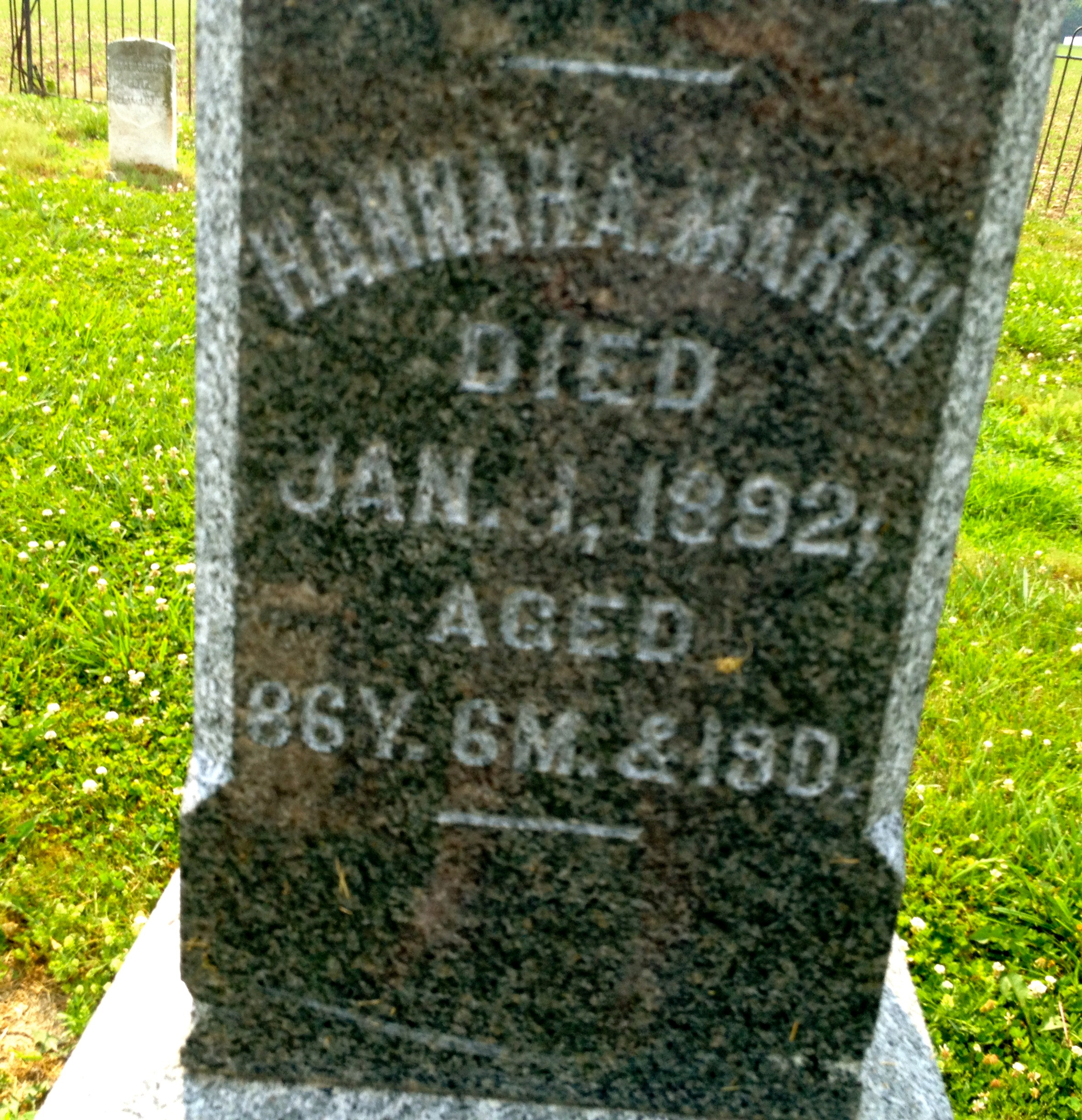
    Enhanced photo. Hannah A. Marsh. That may be Enoch Danford's Civil War stone in the background. Born Hannah Johnson, daughter of Abner Johnson and wife Jane Kirkpatrick, she first married A.L. Hedges (his name also shown as Anthony Ludwig [sic] Hedges and Anthony Ludlow Hedges); second she married George Tabor Marsh, whose first wife was nee, Sarah Ann Smith. These notes are sourced from a letter written by Norma Kidd Greene (Mrs Roy Greene of Lincoln Neb) in an excerpt from a 1976 Colerain Twp. publication (which I do not possess). Hannah Johnson Hedges Marsh's three daughters with A.L. Hedges are written there as Jane Hedges Matson, Eliza Hedges Sater, and Mary Hedges Lamb. Are living Hedges line descendants out there? Please write. Norma Kidd Greene's letter is said to be within a book: Source: Bicentennial publication: Our Heritage: Colerain Township, Ohio. Colerain Twp. Bicentennial Committee, 1976. Also....Aprille Cooke McKay of Ann Arbor, MI posted (1998) that her full name was nee, Hannah Ayers Johnson.
    Added by: DBardes
    10/21/2012


    http://www.findagrave.com/cgi-bin/fg.cgi?page=pv&GRid=18007655